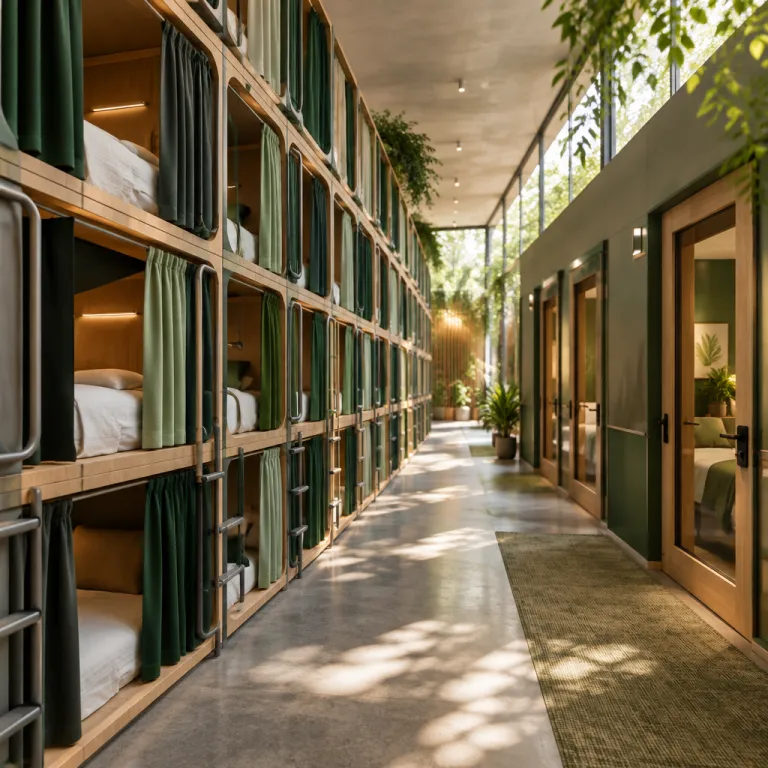
The density advantage: why more pods change the revenue math
Walk into a well designed capsule hotel and the first thing you feel is density used intelligently, not austerity. In the same footprint where a traditional hotel would squeeze in 100 to 150 rooms, a global capsule concept can install 250 to 350 pods with full digital infrastructure and refined shared spaces. For travelers used to large suites, this shift in scale is the starting point for understanding capsule hotel revenue unit economics and why 300 pods at 65 percent occupancy can outperform 150 rooms at 80 percent.
Each capsule is a revenue generating bed rather than a large, underutilized room, and that bed count is the key driver of the hotel business model. When you multiply a modest nightly rate by 300 pods instead of 150 rooms, the total revenue per square metre often exceeds that of many premium hotels in the same hotel market, especially in city centre locations with strong travel demand. The market growth of capsule hotels in Asia, Europe and North America reflects this simple but powerful density advantage, which investors now treat as a distinct asset class within the wider hotels landscape.
For guests, this density does not have to feel cramped when the pod layout, circulation and acoustic engineering are handled by a serious design équipe. A capsule hotel that allocates generous lounge areas, co working tables and spa style showers can feel more like a private club than a hostel, even when every pod is occupied. The best capsule hotels use data on guest flows and group patterns to separate quiet segments, such as solo travelers on business, from social segments, such as leisure travelers returning late from the city.
From a revenue perspective, the key metric is not just RevPAR but revenue per available pod, which behaves differently from a traditional room based KPI. A 300 pod property running at 65 percent occupancy sells 195 pods per night, while a 150 room hotel at 80 percent sells 120 rooms, so the capsule hotel revenue unit economics favour the higher unit count even at a lower occupancy rate. When you layer in dynamic pricing by booking mode and length of stay, the capsule hotel can flex its rates to capture both high yield business travelers and price sensitive leisure guests without diluting its positioning.
Luxury leaning capsule hotels in Tokyo, Singapore and north America now experiment with tiered pod categories, from standard capsule to premium pod with more privacy and amenities. This segmentation allows the property to stretch its average daily rate while still offering an accessible entry price for younger travelers with lower disposable income. For a premium booking website, showing these segments clearly — from quiet business pods to social group pods — is essential to help guests choose the right bed and to keep expectations aligned with the compact mode of stay.
When you compare the market size of capsule hotels to the wider hotel market, the category is still small but its growth rate is structurally higher. Analysts tracking the global capsule segment point to sustained double digit market growth in key urban hubs, driven by rising travel volumes and the search for better value in prime locations. For guests browsing a luxury and premium booking platform, this means more choice in cities where traditional hotels either feel overpriced or pushed to the outskirts.
On the ground, the density advantage is most visible in properties like Bed Tokyo or Bed KLCC, where every square metre is engineered around the bed as the core product. These hotels show how a capsule can be both a compact sleeping pod and a carefully tuned acoustic cocoon, allowing business travelers to sleep deeply a few metres from a busy lobby. When you book bed options in these properties through a curated booking website, you are effectively choosing between different revenue units, each with its own yield profile for the operator.
For premium capsule hotels, the bargaining power of guests is shaped by location and design rather than by room size. In districts with limited supply, such as central Tokyo or Manhattan, a well executed capsule hotel can command rates that would surprise travelers who still associate capsules with budget hostels. The capsule hotel revenue unit economics reward owners who invest in high quality pods, strong sound insulation and elevated shared spaces, because these elements justify higher rates per bed while keeping construction costs under control.
Construction and operating economics: why pods pay back faster
The second pillar of capsule hotel revenue unit economics is construction cost, which is where pods quietly rewrite the rulebook. A traditional upscale hotel room requires heavy structural work, complex bathroom layouts and extensive fit out, while a capsule hotel can install prefabricated pods with integrated lighting, ventilation and storage in a fraction of the time. That difference in capital expenditure per bed is why investors now run serious analysis on capsule hotels as a distinct real estate play rather than a niche curiosity.
In practical terms, a developer can often fit 300 pods into a building where only 120 to 150 conventional rooms would have been feasible, and each pod costs significantly less to build and furnish than a full room. When you divide total project cost by the number of revenue generating beds, the cost per bed in a capsule hotel can be less than half that of a comparable city centre hotel, even when you invest in premium finishes and generous shared spaces. This lower cost base shortens the payback period, which is why the size forecast for the global capsule segment continues to be revised upward in many market reports.
Operating costs follow the same logic, because smaller private spaces and larger shared zones change staffing and maintenance patterns. A capsule hotel can run with fewer front desk staff thanks to digital check in, automated booking mode flows and app based communication, while housekeeping focuses on high turnover but compact pods and shared bathrooms. For travelers, this often translates into faster service and more staff presence in social areas, which matters more than someone knocking on a door to turn down a duvet.
Food and beverage is another area where capsule hotels diverge from traditional hotels, with lower overheads but also lower ancillary revenue. Many capsule hotels skip full service restaurants and room service, opting instead for a well curated café, a bar and partnerships with local restaurants that deliver. This keeps labour and inventory costs lean, but it also means the business must rely more heavily on bed revenue and smart pricing across different booking segments and booking modes.
For a luxury and premium booking website, the key is to surface these differences transparently so travelers understand what is included in the rate. A guest comparing capsule hotels in Europe to traditional hotels might see similar nightly prices but very different inclusions, from breakfast policies to spa access. Articles such as the analysis of Europe’s capsule hotel boom and how it differs from Japan, available on this in depth European capsule overview, help frame those expectations for discerning travelers.
From an investor’s perspective, the forecast period for recovering initial capital is often shorter in capsule hotels because of the combination of lower build cost and higher bed count. When a 300 pod property reaches a stable 65 percent occupancy with disciplined rate management, the cash flow can outpace that of a 150 room hotel at 80 percent occupancy, especially in markets with strong year round travel demand. This is why the global capsule category attracts both hospitality groups and real estate funds looking for resilient, high density urban assets.
Maintenance economics also favour the capsule model, since pods are modular and can be replaced or upgraded without taking entire floors out of service. A hotel that operates with traditional rooms often faces long renovation cycles, while a capsule hotel can phase upgrades pod by pod, keeping most of its inventory online. For travelers booking through a premium platform, this means more properties that feel freshly updated, even in older buildings that have been repurposed into capsule hotels.
In cities where land values are high and planning rules encourage adaptive reuse, capsule hotels have become a preferred mode of breathing new life into underused buildings. The detailed feature on how capsule brands are reviving vacant city buildings, available via this urban regeneration case study, shows how the model works in practice. For guests, staying in such a property means sleeping in a pod that sits where an office cubicle or job centre desk once stood, with the same central address but a very different energy.
Global market insights: segments, brands and the new capsule luxury
Look at the global data on capsule hotels and a clear pattern emerges, with three main segments driving market growth. First come solo travelers, especially business guests who value location and reliability over room size, then small group travelers who treat the capsule hotel as a social base, and finally price sensitive but design conscious leisure travelers who want to stretch their disposable income without sacrificing style. Each of these segments responds differently to pricing, booking mode options and the perceived value of shared spaces versus private pods.
In north America and Europe, capsule hotels are evolving away from their original Japanese template into more lifestyle driven concepts with stronger design narratives. Brands such as Pangea Pod in Whistler, Nonze Hostel in Pattaya, Riccarton Capsule in Wellington, Bed KLCC in Kuala Lumpur and Bed Tokyo in Japan each interpret the capsule differently, from ski town social hub to urban minimalist retreat. For a luxury and premium booking website, curating these hotels side by side allows travelers to compare not just rates but also the underlying capsule hotel revenue unit economics that shape the guest experience.
Some capsule hotels lean into the hostel energy, with larger social zones and events that attract younger travelers and digital nomads. Others operate more like compact business hotels, with quiet floors, strong soundproofing and pods that feel closer to a first class airline suite than a bunk bed. The hotel market now recognises capsule hotels as a flexible format that can stretch from elevated hostel to near luxury, depending on how the operator balances bed density, shared amenities and service levels.
For investors and analysts, the key question is how large the market size for capsule hotels can become before saturation. Current size forecast models for the global capsule segment suggest room for substantial expansion in secondary cities, where land is cheaper but travel demand is rising, especially among younger travelers. A thoughtful analysis of capsule hotel brands building regional empires, such as Tarka, CityHub and Code, is available via this capsule brand strategy feature, which shows how scale and standardisation can further improve capsule hotel revenue unit economics.
On the guest side, the bargaining power of travelers has increased as more capsule hotels enter the market and compete on design, technology and service rather than just price. A premium booking platform can use transparent reviews, clear photography of pods and shared spaces, and detailed amenity lists to help travelers choose the right capsule hotel for their needs. When guests understand exactly what a pod offers — from mattress quality to ventilation and storage — they are more willing to pay a higher rate per bed, which supports sustainable market growth.
Different booking modes also shape the economics, from direct booking on brand sites to reservations through online travel agencies and curated platforms. For capsule hotels, the choice of mode booking is not just a distribution decision but a strategic lever that affects acquisition cost per guest and long term loyalty. A luxury focused booking website that sends well informed, high value travelers can justify slightly higher commission because these guests tend to book longer stays and return to the same capsule hotel group in other cities.
As capsule hotels expand globally, data driven revenue management becomes essential to balance occupancy, rate and guest mix. Operators track not only traditional KPIs but also pod specific metrics, such as revenue per bed, average length of stay by segment and ancillary spend in shared spaces. For travelers, this behind the scenes sophistication translates into more tailored offers, from weekday business packages for solo travelers to weekend group deals that make a capsule hotel stay more attractive than a standard hotel room.
In this evolving landscape, capsule hotels that invest in strong design, clear positioning and thoughtful service will capture the most resilient share of the market. Guests booking through premium platforms will increasingly treat the capsule not as a compromise but as a deliberate choice that aligns with how they actually use a city hotel. The winners will be those operators who understand that the pod is only one part of a broader experience that includes social energy, privacy, technology and a sense of place.
What this means for discerning travelers: reading between the revenue lines
Understanding capsule hotel revenue unit economics is not just an investor exercise ; it is a practical tool for travelers who want better value from every trip. When you know that a 300 pod property at 65 percent occupancy can outperform a 150 room hotel at 80 percent, you start to see why some of the best located capsule hotels feel surprisingly polished for their price. The maths behind the pods explains why you can sleep steps from a financial district or major station without paying traditional five star rates.
For business leisure travelers extending a work trip into a weekend, the key is to look at how each capsule hotel allocates its savings. Some properties reinvest lower construction and operating costs into higher quality beds, better soundproofing and generous lounges, while others simply chase volume. A premium booking website can help by highlighting capsule hotels where the balance between density and comfort is handled with care, using guest reviews and on site inspections rather than marketing promises.
When you compare options, focus on three elements that sit at the heart of capsule hotel revenue unit economics. First, check the number of pods versus the size of the building to understand how dense the layout is and how that might affect noise and privacy. Second, look at the mix of solo travelers and group bookings in reviews, because a capsule hotel that leans heavily toward large groups may feel very different from one designed around business travelers.
Third, pay attention to booking mode and flexibility, since capsule hotels often use dynamic pricing to manage occupancy across different segments. Direct booking may include early check in, lounge access or late checkout, while third party booking can offer sharper rates but fewer perks. For travelers with high disposable income but limited time, paying a little more for flexibility and quiet zones can transform a compact pod into a genuinely restorative base.
Examples such as Nonze Hostel, Pangea Pod, Riccarton Capsule, Bed KLCC and Bed Tokyo show how different capsule hotels translate similar economics into distinct guest experiences. Nonze Hostel leans into social energy with a strong hostel vibe, while Pangea Pod positions itself as a design forward base for outdoor enthusiasts, and Riccarton Capsule focuses on efficient comfort for urban explorers. When you book bed options in these properties, you are effectively choosing between different interpretations of the same underlying business model.
For travelers who value transparency, capsule hotels can feel refreshingly honest, because the product is the bed and the pod, not an oversized room you barely use. The shared spaces become the living room of the hotel, where you work, meet and unwind, while the capsule remains a quiet retreat. This clarity of purpose aligns well with the expectations of solo travelers and small groups who care more about location, cleanliness and atmosphere than about square metres.
As the global capsule segment matures, expect more differentiation between quiet, business oriented capsule hotels and louder, social properties that blur into hostel territory. A luxury and premium booking website can play a crucial role by segmenting these hotels clearly, using tags, filters and editorial curation to guide travelers toward the right choice. In a crowded hotel market, that level of guidance is what turns raw market data into meaningful decisions for guests.
Ultimately, the reason 300 pods at 65 percent occupancy can outperform 150 rooms at 80 percent is simple : more revenue units, lower cost per unit and a guest base that increasingly understands the trade offs. For travelers willing to embrace the capsule concept, this means access to prime locations, thoughtful design and often a more social, contemporary way to stay. For investors and operators, it means a business model that can weather cycles, adapt to changing travel patterns and continue to redefine what a city hotel can be.
Key statistics on capsule hotel economics and market growth
- In major Asian cities such as Tokyo and Osaka, capsule hotels can reach bed densities of more than 250 pods in buildings where traditional layouts would allow roughly 100 to 150 rooms, according to industry analysis from regional hospitality consultancies.
- Global market research firms have reported that the capsule hotel segment has grown at a faster rate than the overall hotel market in recent years, with several studies indicating high single digit to low double digit annual growth in key urban hubs worldwide.
- Case studies from operators in Japan and Europe suggest that construction costs per bed in capsule hotels can be 30 to 50 percent lower than in comparable city centre hotels, due to modular pod installation and reduced private floor area per guest.
- Operational data shared by several capsule hotel groups indicates that staff to guest ratios can be reduced by up to 20 to 30 percent compared with traditional hotels of similar capacity, thanks to digital check in, streamlined housekeeping and simplified food and beverage offerings.
- Industry benchmarks show that capsule hotels often achieve shorter payback periods on initial investment, with some urban properties reaching stabilised performance within a few years of opening, supported by high bed counts and strong demand from solo travelers and small groups.
Sources
- STR Global, urban hotel and alternative accommodation performance reports.
- JLL Hotels & Hospitality Group, research on compact accommodation and adaptive reuse.
- CBRE Hotels, market insights on limited service and high density hotel formats.